Dream. Design. Do.
Hands-on science, technology, engineering and math, inspired by real space missions. For students, families and neighbors in Atlanta, Tuskegee and California.
See us at Space Day Atlanta
Saturday, October 3, from 10 a.m. to 2 p.m. at Fernbank Science Center. It’s free for everyone. Watch a drone-soccer demo and see how a soccer pitch becomes a Moon mission.
Pick your mission
Five ways to learn by doing. Programs open in stages, so join the list and we’ll tell you when one opens near you.
Join the list-
Drones on the Moon
Soccer STEM – Drones on the Moon
Play drone soccer, then turn the pitch into a map of the Moon’s south pole and fly missions to hunt for water ice.
- Who
- Grades K–12 and college teams
- Where
- Atlanta, Georgia
-
Healthy neighborhoods
ORISHA STEM
Use sensors, maps, satellite images and AI to study your neighborhood’s air, water and food, then share what you find.
- Who
- Grades 5–12, college students and educators
- Where
- Atlanta, Georgia
-
Space biology and health tech
BioHealth Technologies & Applications
Find out how living things change in space. Run experiments with yeast and explore wearable health sensors.
- Who
- High school and college students
- Where
- Tuskegee, Alabama
-
Space engineering academy
HFF-Endeavour Space Engineering Institute & Academy
Learn how satellites work by building one: GECKO, a stackable classroom CubeSat about the size of a loaf of bread.
- Who
- Grades 8–12
- Where
- California
-
Inventors’ lab
HFF-West Technology Incubator
Turn your idea into a real product for space, Earth and humanity, one lab at a time: learn, dream, build, prove and sell.
- Who
- High school, college and early-career makers
- Where
- California
Start where you are. Keep climbing.
Every HFF program follows the same five steps, from pre-K to early career. We call it ESTEEM: STEM plus education, entrepreneurship and management.
- Exposure
See it
Catch a demo, visit an exhibit or meet a real engineer.
- Entry
Try it
Fly your first drone, read your first sensor, join a club.
- Experiment
Build it
Design, build and test a project with your team.
- Engagement
Lead it
Take on real missions and contests, and mentor younger students.
- Expert
Launch it
Head to college, a career, research or a company of your own.
There’s a place for you
Students
- Join a program or club session near you
- Bring your friends to a demo day
- Climb from Exposure to Expert, one step at a time
Families
- Find a program that fits your child’s age and interests
- Come to family events like Space Day Atlanta
- Ask us to bring a program to your school or club
Teachers
- Bring ready-to-teach lessons to your class or club
- Join teacher training workshops
- Apply to become an HFF STEM Teacher Fellow
Neighbors
- Mentor a student team or judge a challenge
- Help out at events in your area
- Share your skills in science, health, business or the trades
Built on NASA know-how
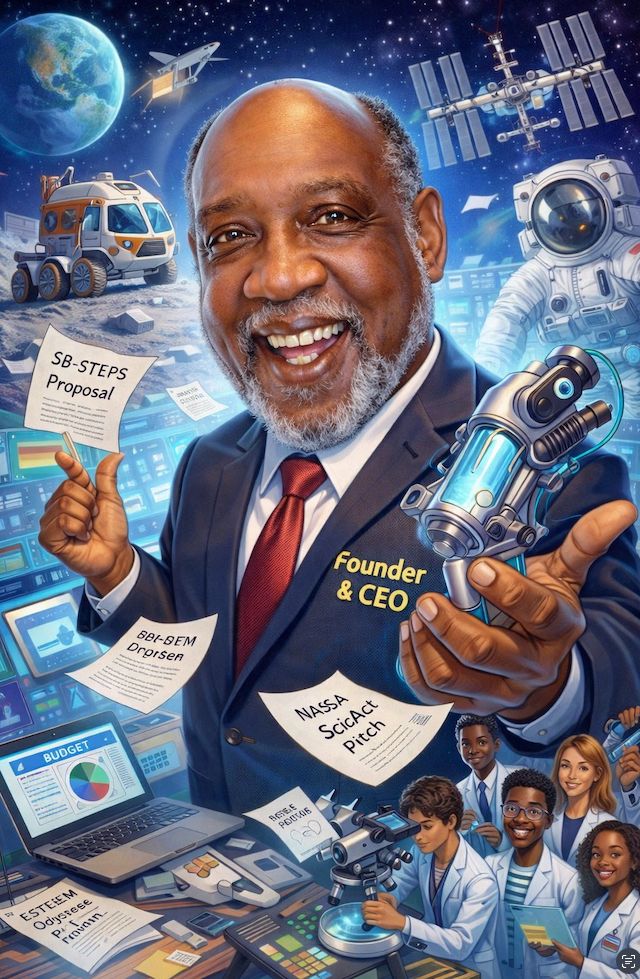
HFF founder John W. Hines, an electrical engineer trained at Tuskegee University and Stanford, spent nearly four decades at NASA Ames Research Center and retired as its Chief Technologist. He helped fly living experiments aboard the Space Shuttle and on satellites, some no bigger than a loaf of bread.
Today HFF brings that learn-by-doing spirit to students, especially in communities whose talent has too often been underutilized. The next generation of explorers can come from any neighborhood.
Where we work
Atlanta, Georgia
Home base for Drones on the Moon, healthy neighborhoods and teacher training.
California
HFF-West, home of the inventors’ lab and space engineering academy.
Tuskegee, Alabama
Space biology and health tech, with Tuskegee University.
Our partners
- Tuskegee University
- Morehouse College
- AUC Data Science Initiative
- University of Washington
- Fernbank Science Center
- FIDA USA
- STEAMsport
- GaiaVerse
- Space Information Labs
Questions families ask
Who can join?
Students from pre-K through early career. Most programs serve middle and high schoolers, Drones on the Moon starts in kindergarten, and our labs welcome college students and early-career makers.
Do I need any experience?
No. Every path starts with seeing and trying something new. You move up a step whenever you’re ready.
Is drone flying safe for kids?
Safety comes first. Sessions start with safe-flight training, soccer drones fly inside protective cages, and students can earn the FAA’s free TRUST certificate.
What does it cost?
[Add program fees, scholarships and free options here.]
Can my school or group host a program?
Yes. Tell us about your school, club or community group using the form below, and our team will follow up.
Are gifts tax-deductible?
HFF is a 501(c)(3) nonprofit (EIN 82-1268652), so gifts are tax-deductible to the extent allowed by law.
Be the first to know
Tell us who you are and what you’re curious about. We’ll let you know when programs and events open near you.
Under 13? Ask a parent or guardian to sign up for you.